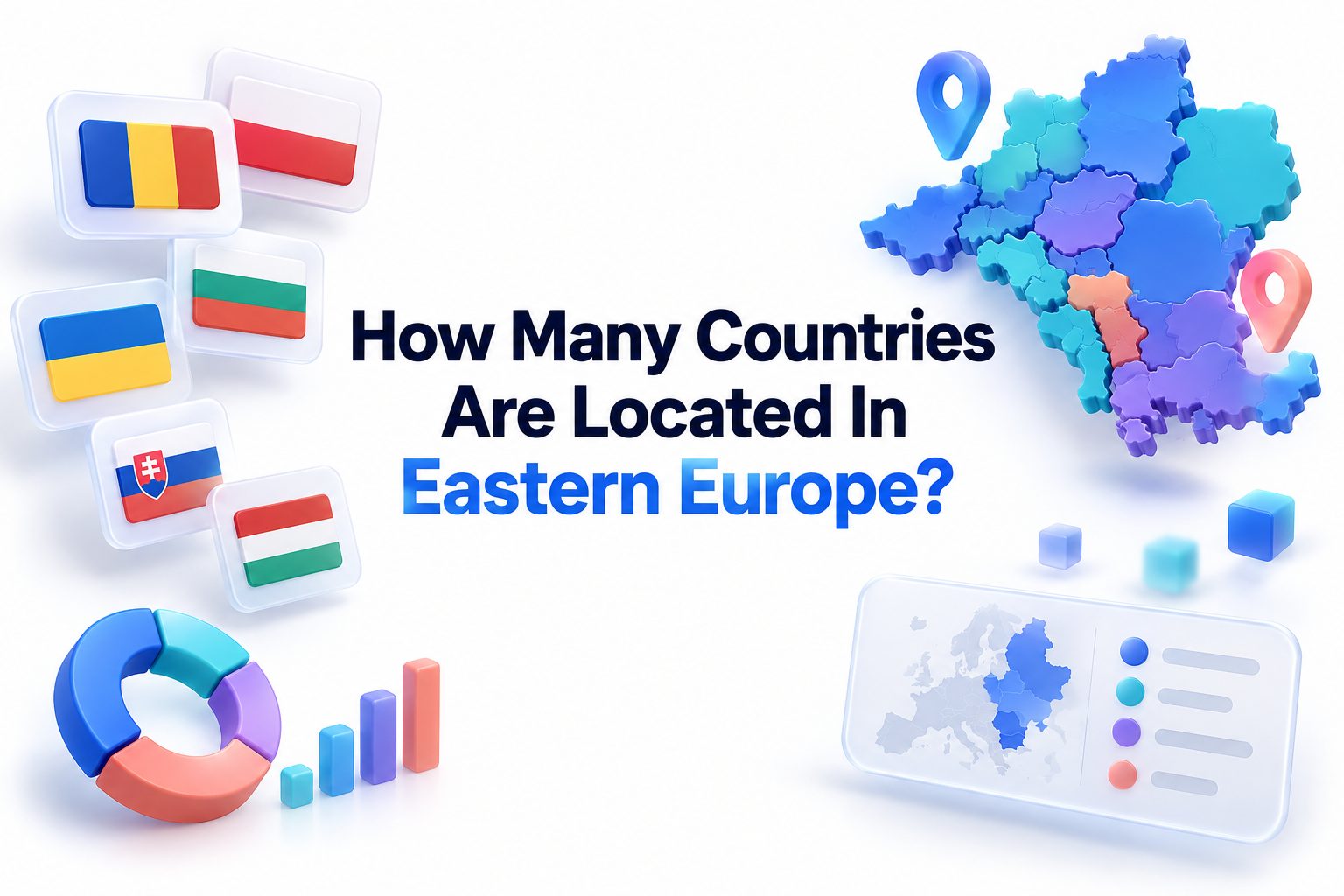
Many travelers and students often ask how many countries are located in eastern europe, because the answer changes with the source you check. Some lists show ten countries, while others show more than twenty. The difference comes from history, politics, and geography, not from a simple map line.
Eastern Europe sits between Central Europe and Western Asia, and its borders have shifted many times. Empires, wars, and the breakup of the Soviet Union all redrew the region. That is why textbooks, news outlets, and global agencies do not always agree.
In this article, we will break down the numbers in a clear way. You will learn which countries are almost always included, which ones are sometimes added, and why the United Nations list looks different from travel guides.
Defining Eastern Europe in Modern Geography
Eastern Europe has no single natural border that everyone accepts. The Ural Mountains mark the east, but the western edge is cultural and political. Many geographers place it east of Germany, Austria, and Italy, stretching toward Russia and Turkey.
This flexible definition causes most of the confusion about numbers. A country like the Czech Republic can appear in Central Europe in one book and Eastern Europe in another. The same happens with the Balkans and the Baltic states in everyday use.
The Most Widely Accepted Country Count
Most popular references say ten countries form the core of Eastern Europe. These are Russia, Ukraine, Belarus, Moldova, Poland, Hungary, Slovakia, Romania, Bulgaria, and the Czech Republic. This group shares Cold War history and post Soviet change.
When people ask how many countries are located in eastern europe in casual talk, they often expect this ten country answer. It is simple, familiar, and used by many schools, blogs, and travel sites for quick regional grouping.
Quick Facts About the Core Ten
-
- Russia is the largest country in the region by land and spans two continents
- Ukraine is the largest country fully inside Europe by land area
- Poland has the biggest economy among the core ten in many yearly rankings
- Romania and Bulgaria joined the European Union in the year 2007
- Hungary, Poland, Slovakia, and the Czech Republic form the Visegrad Group
- Belarus and Moldova retain the strongest post Soviet economic links
United Nations View of Eastern Europe
The United Nations Statistics Division lists ten countries under Eastern Europe for statistical work. Its list includes Russia, Ukraine, Belarus, Moldova, Poland, Hungary, Slovakia, Romania, Bulgaria, and the Czech Republic. This is a practical grouping, not a political judgment.
This UN list is widely quoted because it is stable and neutral. Researchers like it for comparisons. However, it leaves out the Baltic states and much of the Balkans, which other systems place in Northern or Southern Europe.
Baltic States and Their Regional Placement
Estonia, Latvia, and Lithuania are often linked to Eastern Europe in history books. They were part of the Soviet Union and share many twentieth century experiences with neighbors. In travel talk, many visitors still group them with the east.
The United Nations, however, places the Baltic states in Northern Europe. That one choice removes three countries from the eastern count. If you add them back for cultural reasons, the total rises from ten to thirteen very quickly.
Countries Included in the Wider Definition
A wider view can raise the total to eighteen or more. This version adds the Baltic states plus Albania, Bosnia and Herzegovina, Croatia, Montenegro, North Macedonia, and Serbia. Some versions also add Kosovo, Slovenia, and parts of the Caucasus area.
Wider lists are common in news and tourism. They focus on shared history, Orthodox and Slavic heritage, and former socialist systems. While useful for storytelling, they mix UN subregions and can confuse readers who want one fixed number.
Key Factors That Change the Total
-
- Source type: UN lists differ from CIA, EU, and travel publisher lists
- Baltic choice: Adding Estonia, Latvia, and Lithuania adds three countries
- Balkan choice: Adding Western Balkan states can add six or seven countries
- Transcontinental view: Russia, Turkey, Georgia, and Kazakhstan span continents
- Recognition status: Kosovo and Transnistria are counted only in some lists
- Time period: Soviet, Yugoslav, and Czechoslovak breakups increased the count
Historical Roots Behind the Current Borders
After World War Two, Eastern Europe came to mean the Soviet bloc in the east. That bloc included the USSR, Poland, Czechoslovakia, Hungary, Romania, Bulgaria, Albania, and Yugoslavia. The label was political more than strictly geographic in daily speech.
When the Soviet Union and Yugoslavia broke apart, many new states appeared. Czechoslovakia split into two. This history explains why older maps show fewer countries while modern maps show many more in the same land space.
Cold War Legacy in Regional Grouping
The Cold War fixed the idea of East versus West for decades. School atlases colored NATO members one way and Warsaw Pact members another. That color split still shapes how older readers picture the region today.
Modern writers try to move past that split. They use Central Europe for Poland, Hungary, Slovakia, and the Czech Republic. That shift lowers the eastern total in some books, even though the land itself has not moved at all.
Soviet Successor States in the East
Russia, Ukraine, Belarus, and Moldova are direct successor states of the Soviet Union in Europe. They form the eastern core of almost every list. Their languages, rail links, trade ties, and energy networks still show that shared past.
These four alone cover most of the land area people call Eastern Europe. Russia extends far into Asia, while Ukraine, Belarus, and Moldova sit fully in Europe. Any honest count must start with this group before adding neighbors.
Practical Tips for Reading Country Counts
-
- Check the source date, because older lists miss newer states and name changes
- See if the Baltic states are placed in the north or the east
- See if Balkan countries are placed in the south or the east
- Note how Russia and Turkey are handled as transcontinental states
- Compare UN data with EU and travel guides before quoting a number
- For school work, cite which definition you follow and why it fits
Central Europe Overlap and Confusion
Poland, Hungary, Slovakia, and the Czech Republic are now often called Central Europe. The European Union, travel brands, and many academics prefer this term. It reflects EU membership, strong trade with Germany, and central location on the map.
If you move these four to Central Europe, the eastern total drops sharply. Some lists then show only Russia, Ukraine, Belarus, Moldova, Romania, and Bulgaria. Readers should know this shift when they compare two maps side by side.
The Balkans and Southeast Placement
Croatia, Serbia, Bosnia and Herzegovina, Montenegro, Albania, and North Macedonia are usually called Southeast Europe or the Western Balkans. The United Nations places most of them in Southern Europe, which keeps them out of the eastern group.
Travel writers still mix them into Eastern Europe for ease. The food, history, and architecture feel connected across the border. If you include them, how many countries are located in eastern europe can jump from ten to sixteen or seventeen.
Transcontinental Countries
Russia spans Eastern Europe and Northern Asia, with most land in Asia but most people in Europe. Turkey, Georgia, Azerbaijan, and Kazakhstan also cross regional lines. Different agencies assign them to different subregions for reports.
For a strict Europe only count, most writers include Russia but leave Turkey and the Caucasus out. Others add Georgia, Armenia, and Azerbaijan to a greater eastern list. Always check footnotes to see how each source draws the line.
Population and Size Comparison Notes
Size changes how we view the region more than people expect. Russia alone is larger than all other eastern states combined. Ukraine follows as a large middle power, while Moldova and the Balkan states are small but densely settled.
Population is more balanced than land size suggests. Poland, Ukraine, and Romania hold large populations and labor markets. Smaller states like Estonia and Montenegro matter for tech, tourism, and ports despite their limited area and numbers.
Why Different Maps Show Different Numbers
Different maps serve different needs, so they group land in different ways. A statistical map wants equal data blocks. A travel map wants useful trip clusters. A history map wants to show empires and alliances that no longer exist.
Because of these goals, one map shows ten while another shows twenty. Neither is wrong if the method is clear. Problems start only when writers quote a number without naming the list or year behind it. See our European travel guides [Internal Link: European travel guides] for route ideas across these zones.
Helpful Ways to Use the Numbers
-
- Use the ten country UN list for clean data and school citations
- Use the thirteen country list when adding the Baltic states for history
- Use the eighteen to twenty country list for broad travel planning
- State your method in one line before giving any total
- Link to country profiles so readers can verify borders and capitals
- Update old posts when names, borders, or EU status change over time
Language and Culture Across the Region
Language families help explain why the region feels connected. Slavic languages dominate in Poland, Slovakia, Czechia, Ukraine, Russia, Belarus, Bulgaria, Serbia, and Croatia. Romanian, Hungarian, Albanian, and Estonian follow different roots but share long contact.
Religion, food, and festivals also cross borders. Orthodox churches, Catholic towns, hearty stews, and folk music appear in many states. These ties make a wider eastern count feel natural, even when formal data keeps groups apart. Learn more in our Eastern European culture overview [Internal Link: Eastern European culture overview].
Economy and Travel Links in the East
Trade and travel bind these countries more tightly each year. Poland, Hungary, Slovakia, Romania, and Bulgaria use EU funds for roads and rail. Ukraine, Moldova, and the Western Balkans grow links through deals, ports, and energy routes.
For visitors, this means easy multi country trips by train or low cost flight. You can start in Krakow, cross into Slovakia, and reach Budapest in days. A clear country list helps plan visas, money, and time without stress.
Conclusion
The safest short answer is ten countries in the strict UN sense, rising to thirteen with the Baltics and near twenty in broad travel use. Each total is correct within its own method, which is why context matters more than a single fixed figure. Pick the list that fits your goal, name your source, and your readers will trust your work. That clear habit settles how many countries are located in eastern europe without confusion.
FAQ
What counts as Eastern Europe for most standard lists
The standard UN list counts ten states, including Russia, Ukraine, Belarus, Moldova, Poland, Hungary, Slovakia, Romania, Bulgaria, and the Czech Republic. It is used for statistics and simple regional comparison.
Why do some guides list more than twenty states in the east
Some guides add the Baltic states, the Western Balkans, and transcontinental neighbors for travel or history. This wider method mixes UN subregions, so the total rises quickly past twenty in some cases.
Are the Baltic states part of Eastern Europe
Culturally many people link them to the east, but the UN places Estonia, Latvia, and Lithuania in Northern Europe. Your total will change by three based on which choice you follow.
Is Russia counted as an Eastern European country
Yes, Russia is counted in almost every eastern list. Most of its land lies in Asia, but its capital, history, and most of its population sit in Europe, so it anchors the group.
Is Turkey part of Eastern Europe in common counts
No, Turkey is usually placed in Western Asia or Southern Europe in formal data. Some broad cultural lists mention it, but most standard eastern counts leave it out for clarity.
0 Comments