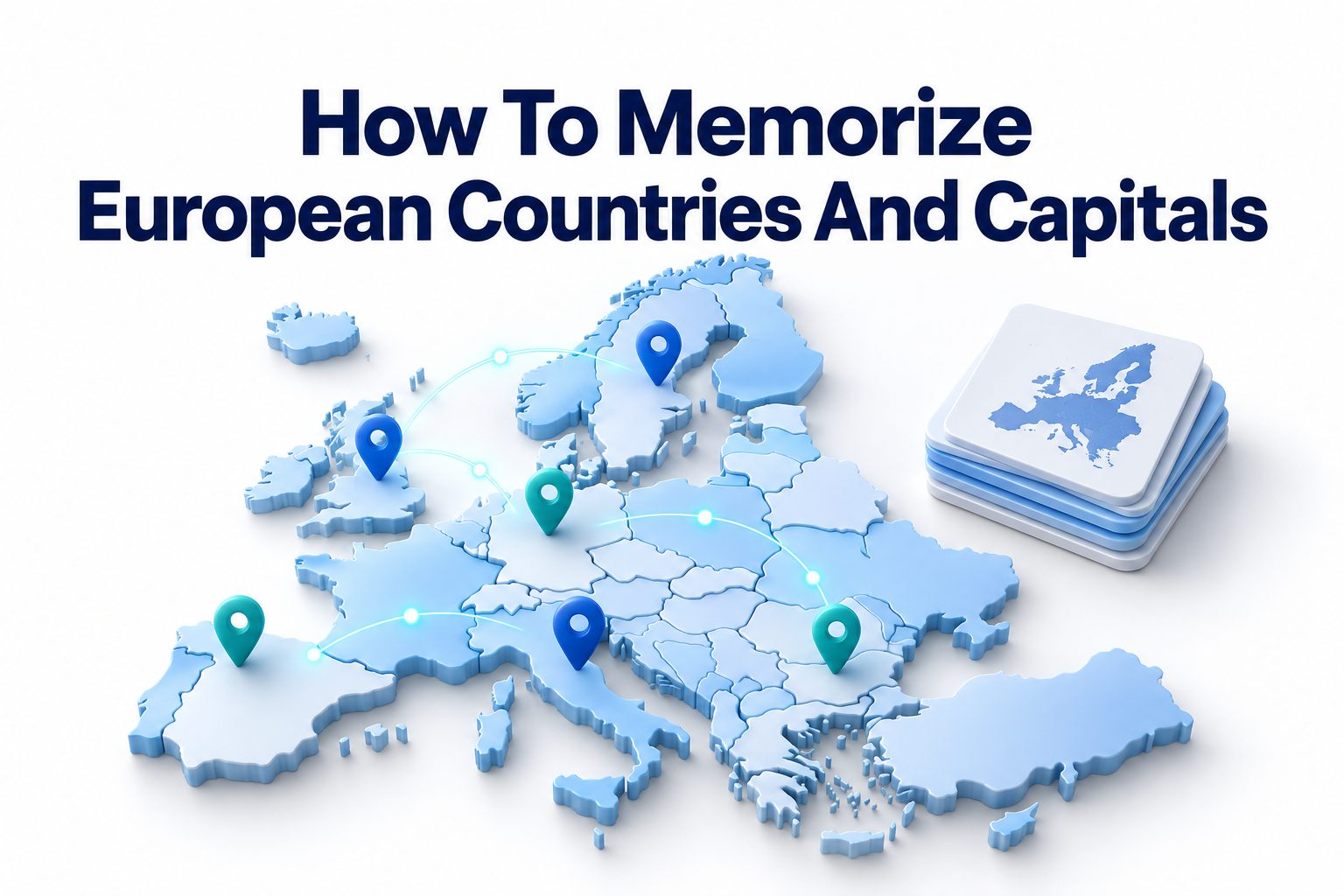
Many students stare at a long list of nations and freeze, unsure where to begin or how to keep everything straight. If you want to learn how to memorize european countries and capitals without stress, you need a clear system rather than endless repetition. Europe has 44 to 50 countries depending on the definition used, plus distinct capitals that often sound unfamiliar at first.
Instead of trying to learn everything in one night, smart learners break the continent into small regions, use visual memory, and review in short daily sessions. This approach saves time, builds confidence, and helps facts stay in long-term memory. In this article, you will get practical methods that actually work for exams, quizzes, travel, and general knowledge.
Why European Geography Feels Overwhelming at First
Europe looks small on a world map, yet it packs many borders, languages, and histories into a tight space. Names like Bratislava, Ljubljana, and Chisinau can feel confusing when you see them together. Without a pattern, your brain treats each pair as isolated data and forgets it quickly.
Pressure makes it harder, especially before a test or competition. When you cram 40 capitals at once, recall drops sharply after a day. The solution is to slow down, organize countries logically, and connect each capital to something familiar and visual.
Start With Regions Instead of Random Lists
Dividing Europe into north, south, east, west, and central zones makes learning far more manageable. You might focus on Scandinavia first, then move to the Balkans or the Baltic states. Each region shares language roots, climate themes, and border patterns that aid memory.
Study one region for two to three days before adding the next. Draw its outline, label the countries, and say each capital aloud. This focused repetition builds strong associations. For extra practice ideas, see our detailed article on [Internal Link: European Geography Study Tips].
Key Benefits of Learning by Region
- Smaller groups reduce mental overload and improve daily recall
- Neighboring countries create natural links for faster association
- Shared history helps you remember tricky names with context
- Short regional quizzes feel motivating and easy to complete
- Map drawing becomes simpler when you handle one zone at a time
Group Countries by Northern Europe Clusters
Northern Europe includes Norway, Sweden, Denmark, Finland, and Iceland, plus the Baltic nations nearby. Their capitals are Oslo, Stockholm, Copenhagen, Helsinki, and Reykjavik, which become easier when learned as a northern set. Picture a cold coastal route moving from one harbor to the next.
Use simple images to lock pairs in place. Imagine Oslofjord boats in Norway, Stockholm bridges in Sweden, and northern lights over Reykjavik. Linking climate, landscape, and city images gives your brain multiple cues to retrieve each capital later during review.
Master Western Europe Through Stories and Links
Western Europe feels familiar because of France, Germany, Belgium, Netherlands, and Austria. Their capitals are Paris, Berlin, Brussels, Amsterdam, and Vienna. Instead of repeating names blankly, create short stories where each city plays a role tied to its culture and landmarks.
You can link Paris fashion, Berlin history, Brussels chocolate, Amsterdam canals, and Vienna music into one travel tale. When facts live inside a narrative, recall improves greatly. Re-tell the story twice a day and the capital pairs will become automatic quickly.
Quick Checklist for Daily Capital Practice
- Choose only five new country-capital pairs per study session
- Say each pair aloud three times with correct pronunciation
- Write pairs from memory without looking at notes
- Mark difficult ones and review them before sleep
- Test yourself with a blank map every third day
- Mix old and new pairs to strengthen long-term retention
Learn Southern Europe With Maps and Memory Hooks
Southern Europe stretches across Portugal, Spain, Italy, Greece, and Croatia with sunny coasts and ancient cities. Their capitals are Lisbon, Madrid, Rome, Athens, and Zagreb. A color-coded map helps because peninsulas and islands create clear shapes your eyes remember easily.
Attach a strong hook to each city, like Lisbon trams, Madrid plazas, Rome ruins, Athens temples, and Zagreb old town. When you visualize these landmarks during recall, the country name surfaces faster. Keep your map nearby and trace borders with your finger often.
Visual Anchors for Iberian and Italian Neighbors
The Iberian Peninsula holds Portugal and Spain side by side, so picture Lisbon facing the Atlantic while Madrid sits in the center. For Italy, imagine Rome as the heart with Milan and Naples around it. Spatial images prevent mixing up neighbors that often confuse beginners.
Add small sketches next to each capital, such as a tower, boat, or flag detail. These personal drawings act as retrieval cues even if they are rough. Review your sketches weekly, and update them with colors to keep the visual memory fresh and distinct.
Handle Central Europe With Border Patterns
Central Europe includes Poland, Czechia, Slovakia, Hungary, and Switzerland with capitals Warsaw, Prague, Bratislava, Budapest, and Bern. These countries border each other closely, so learning border order helps. Trace a path from Warsaw south to Prague, then east toward Bratislava and Budapest.
Notice name similarities and differences to avoid swaps. Bratislava and Budapest start with B but belong to different countries. Say full pairs like Slovakia-Bratislava and Hungary-Budapest together. Repeated aloud pairing builds accuracy and prevents common mix-ups during timed quizzes.
Capital Clues Hidden in Language and History
Many central capitals reflect history, rivers, and local language. Prague grew around the Vltava River, Budapest formed from Buda and Pest, and Bern has medieval roots. Knowing one background fact per city gives your memory an extra anchor beyond spelling alone.
You do not need deep history, just one simple line per place. Write that fact on a flashcard behind the capital. When you flip cards, read both sides. This layered learning turns dry lists into meaningful knowledge that lasts much longer.
Eastern Europe Country and Capital Pairs at a Glance
Country – Capital – Simple Memory Hint
Ukraine – Kyiv – Picture golden domes along the Dnipro River
Romania – Bucharest – Think grand boulevards and parliament palace
Bulgaria – Sofia – Imagine mountain views near ancient churches
Moldova – Chisinau – Recall vineyards and quiet green parks
Belarus – Minsk – Visualize wide avenues and post-war squares
Use this table for fast review after learning each pair separately. Cover one column and try to recall the missing part. Short daily table drills work well because they force active recall instead of passive reading, which strengthens memory faster.
Tackle Eastern Europe in Small Chunks
Eastern Europe has many countries, so avoid learning them all together. Start with Ukraine-Kyiv, Romania-Bucharest, and Bulgaria-Sofia. These three are large and distinct, making them good anchors. Add Moldova and Belarus only after the first set feels solid.
Speak each pair in full sentences, such as the capital of Romania is Bucharest. Full sentences engage more memory than single words. Test yourself after one hour, then after one day. Spaced checks like this move facts from short-term to durable memory effectively.
Remember the Balkans Without Mixing Them Up
The Balkans include Serbia, Bosnia and Herzegovina, Montenegro, Albania, and North Macedonia. Their capitals are Belgrade, Sarajevo, Podgorica, Tirana, and Skopje. Because borders changed over time, students often confuse them. Learning them in geographic order from north to south helps.
Create a walking route on your map from Belgrade down to Skopje. Stop at each capital and note one unique image, like Sarajevo bridges or Tirana colors. Moving step by step prevents jumbling. Repeat the route until you can list all five without pause.
Practical Tips to Speed Up Capital Recall
- Use flashcards with country on front and capital on back
- Learn correct pronunciation through short audio clips daily
- Draw blank maps from memory twice per week
- Teach pairs to a friend to test real understanding
- Use spaced repetition apps for automatic review timing
- Connect difficult capitals to food, music, or sports images
Use Mnemonics for Tricky Capital Names
Some capitals stick poorly because they sound alike or look unfamiliar. Tirana, Skopje, Chisinau, and Podgorica often cause trouble. Build funny phrases where the capital rhymes with something you know. Humor makes the brain pay attention and store the link longer.
Keep mnemonics short and personal, such as Tirana-banana or Skopje-scooter. Silly is good because unusual images stand out. Write your best three mnemonics on sticky notes. Seeing them daily reinforces weak pairs without extra study time or effort.
Turn Capitals Into Stories That Stick
Stories bind scattered facts into one chain your mind can follow. Take five countries, arrange them as travel stops, and describe what you see in each capital. Include food, weather, and people to make scenes vivid. Vivid scenes are easier to replay than plain lists.
Retell the same journey after two days and add two new stops. This growing story method works well for all of Europe. For more memory methods, explore [Internal Link: Memory Techniques for Geography Exams] and adapt the examples to your own learning style.
Important Facts That Make Review Easier
- Europe commonly lists 44 sovereign states in most school textbooks
- Vatican City has the smallest capital area among European nations
- Some capitals serve as both political and cultural centers
- Island nations like Malta and Cyprus need separate map focus
- Spelling variants exist, such as Kyiv instead of older forms
- Regular five-minute reviews beat long weekend cramming sessions
Practice With Blank Maps and Active Quizzes
Passive reading feels productive but rarely builds lasting recall. Instead, print blank outline maps and fill countries and capitals from memory. Start with one region, then combine two regions as accuracy improves. Mark errors in red and correct them immediately.
Online quizzes add variety and speed. Use timed rounds to simulate exams, then untimed rounds for learning new pairs. Track scores weekly to see progress. When accuracy stays above ninety percent for three sessions, you can safely move to the next region.
Review Systems That Prevent Forgetting Curves
Forgetting is normal unless you schedule reviews. After learning new pairs, review after one day, three days, one week, and one month. Each review can be just ten minutes. This spacing resets the forgetting curve and locks knowledge in place.
Keep a simple tracker with dates and scores. If a pair drops below full recall, bring it back into daily practice. Consistent short reviews protect earlier regions while you study new ones. Over time, total review time shrinks because memories grow stronger.
Conclusion
Building lasting recall takes steady steps, helpful visuals, and regular review rather than last-minute cramming. Break Europe into regions, use stories and maps, practice actively, and space your repetitions. Stay patient and track progress weekly to keep motivation high. Once you follow a clear method for how to memorize european countries and capitals, the full list will feel manageable, and you will recall each pair with confidence in tests, travel, and everyday conversation.
FAQ
How Many European Countries Should Beginners Learn First?
Start with fifteen to twenty major countries across western and southern Europe. Master their capitals fully, then expand eastward and into smaller states. This staged method builds confidence and prevents overload during early study sessions.
Fastest Way to Remember Tricky Eastern Capitals?
Group three pairs at a time and use vivid images plus pronunciation practice. Review them after one hour, one day, and one week. Short spaced drills with flashcards usually fix difficult names within ten days.
Best Daily Routine for Capital Retention?
Study five new pairs for fifteen minutes, then review older ones for ten minutes. Use blank maps twice weekly and a timed quiz on weekends. Keep sessions short, consistent, and focused on active recall.
Useful Tools for Map Based Practice?
Blank printable maps, flashcard apps with spaced repetition, and short geography quizzes work best. Audio pronunciation guides also help. Choose two tools only to avoid distraction and maintain a steady study habit.
Common Mistakes That Slow Down Capital Learning?
Cramming too many pairs at once, skipping map practice, and ignoring pronunciation are common issues. Learners also forget scheduled reviews. Fix these habits by studying smaller sets and testing yourself regularly from memory.
0 Comments